ConsentPixel vs Termly: Consent Enforcement vs Legal-Policy Generation
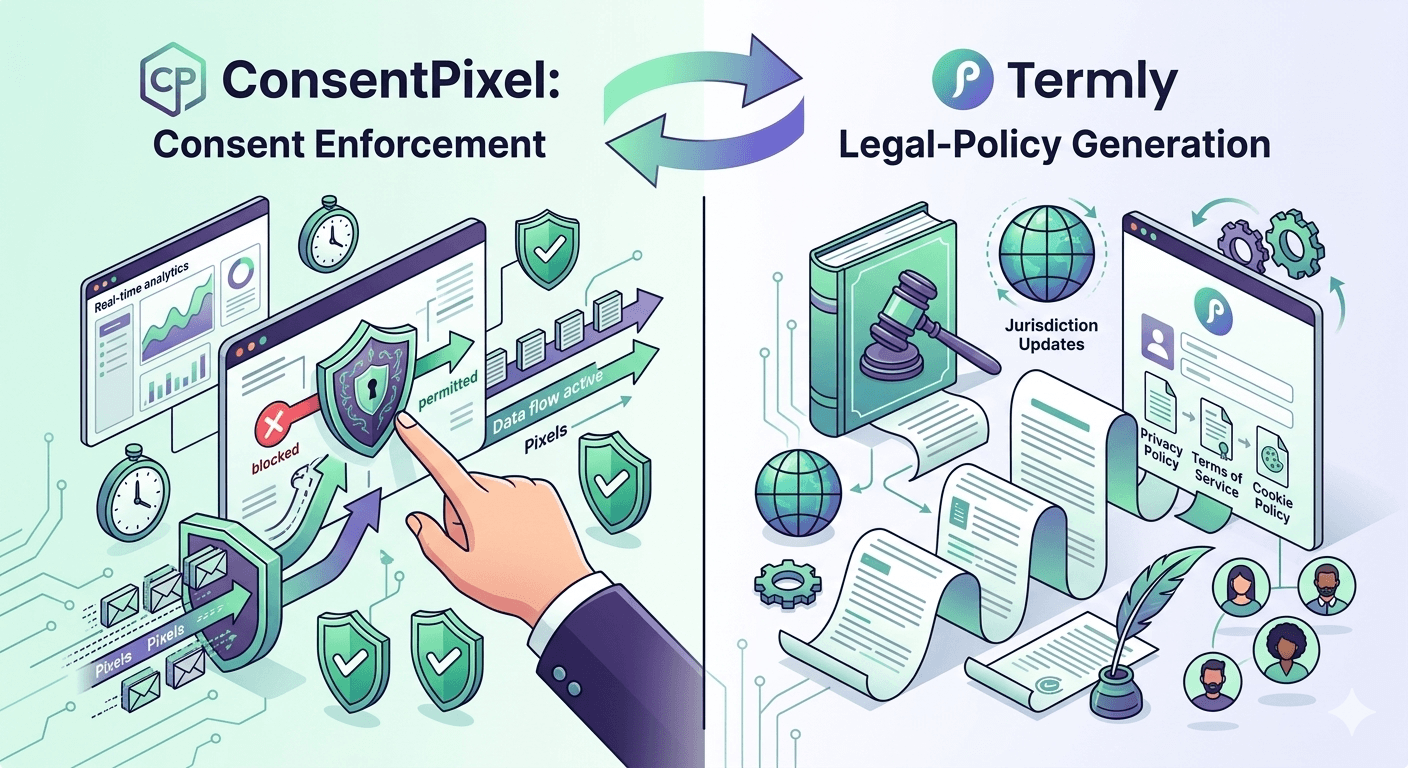
Termly is best known for generating privacy policies and legal documents, with consent management bundled alongside. ConsentPixel is a CIPA-first consent-enforcement platform that also generates privacy policies and terms from your actual scan and consent data — not a generic questionnaire. They overlap on both the cookie banner and policy generation, but their centers of gravity differ: Termly leads with documents, ConsentPixel leads with enforcement. Here's an honest comparison.
In this article
This comparison is a little different from a straight banner-vs-banner matchup, because Termly and ConsentPixel don't have the same center of gravity. Termly is primarily a legal-document platform — privacy policies, terms and conditions, cookie policies, DSAR forms — that also includes a consent manager. ConsentPixel is a dedicated consent-enforcement platform built around US CIPA litigation. Knowing that distinction up front makes the rest of the comparison much clearer.
We'll be fair throughout. Termly is a well-regarded, attorney-backed product that genuinely saves small businesses money on legal documents, and its consent manager is a real, Google-certified CMP. The question isn't whether Termly is good — it's whether the job you're hiring for is "generate my legal policies" or "defend my site against tracking litigation."
The short version
- Termly leads with attorney-crafted legal-policy generation (privacy policy, T&Cs, cookie policy, DSAR) covering ~28 privacy laws, with a bundled consent manager. Best when your main need is compliant legal documents plus a banner.
- ConsentPixel is a CIPA-first consent platform: enforced pre-consent tracker blocking and verifiable, page-scoped records, with flat per-domain pricing. Best when your main risk is US tracking litigation.
- The deciding question: do you need a legal-document generator with a banner attached (Termly), or focused consent enforcement built for the CIPA wave (ConsentPixel)?
What each tool is built for
Termly's origin and strength is legal-document automation. You answer a questionnaire and it generates attorney-crafted policies tailored to your business, then keeps them updated as laws change — covering GDPR, CCPA/CPRA, PIPEDA, and a long list of US state laws. The consent manager (banner, cookie scanning, script auto-blocker, Google Consent Mode v2) is part of the same dashboard, making Termly an "all-in-one compliance starter kit" for small businesses that need documents and a banner without hiring a lawyer.
ConsentPixel leads with enforcement: non-essential trackers are blocked until a visitor genuinely consents, and every consent decision is recorded in verifiable, page-scoped logs you can produce if a CIPA demand letter arrives. But it also generates the legal documents most sites need — privacy policy, terms & conditions, cookie policy — with one key difference from questionnaire-based tools: ConsentPixel builds them from your actual scan results and consent configuration. The policy lists the real trackers found on your site and their purposes, includes the right jurisdiction sections based on where your visitors actually come from, and auto-updates when a new tracker appears or a regulation changes. So you get both layers — enforcement and disclosure — from one platform, with the documents grounded in what's really running on the site.
Termly is a breadth play: documents + consent + DSAR in one place for small businesses. ConsentPixel is a depth play: consent enforcement and evidence built specifically for the litigation risk. Neither is "better" in the abstract — they're answers to different questions.
The legal-policy question
Both tools generate legal documents — but they do it differently, and the difference matters. Termly's generator is questionnaire-driven: you answer questions about your business and it produces attorney-crafted policies across ~28 laws, then updates them as laws change. ConsentPixel's generator is scan-driven: it populates your privacy policy from the trackers actually detected on your site, adds a GDPR rights section if EU visitors are seen and a CCPA section if California visitors are seen, hosts it at a permanent URL, and regenerates it automatically when a new tracker is detected or a regulation changes. Termly's breadth of standalone legal documents (including DSAR workflows) is deeper; ConsentPixel's advantage is that its documents reflect the site's real, current tracking rather than a static questionnaire snapshot. This keeps Termly's genuine strength (breadth of documents) honest while asserting ConsentPixel's real differentiator (scan-driven accuracy). No false claims in either direction.
But it's worth understanding what policy generation is and isn't. A generated privacy policy is a disclosure — it describes what you do. It is not, by itself, technical enforcement of consent. In the CIPA context specifically, what gets businesses sued is not the absence of a policy; it's trackers firing before consent regardless of what the policy says. So the two tools address different layers: Termly is strong at the disclosure layer, ConsentPixel at the enforcement layer.
A privacy policy tells visitors what you do. Consent enforcement controls what actually happens. Both matter — but if your real exposure is CIPA, the enforcement layer is where the risk lives, and a polished policy won't substitute for trackers that fire before consent.
Pricing models compared
Termly's paid plans are inexpensive but oriented around policies and a single included website, with a free tier capped by monthly unique visitors. ConsentPixel uses flat per-domain pricing with no visitor metering.
| Termly | ConsentPixel | |
|---|---|---|
| Free tier | Yes — 1 basic policy; consent banner with monthly unique-visitor cap (banner stops collecting when hit) | Free site scan; paid plans for live banner |
| Entry paid | Starter ~$10–14/mo (limited policies/edits, 1 site) | Starter $8.99/domain/mo, no visitor cap |
| Higher tier | Pro+ ~$15–20/mo (unlimited policies, branding removal, regional rules, subdomain scanning) | Growth $29.99/mo (3 domains), Agency Lite $99.99/mo (10), Agency Pro $199.99/mo (25) |
| Multiple sites | Additional website licenses cost extra | Domains bundled into higher tiers |
| Pricing axis | Per policy set / per site; free tier metered by visitors | Flat per domain — traffic doesn't change the bill |
| Core value in price | Legal documents + consent | Consent enforcement + evidence records |
Termly's headline prices look very low, but that's because the value is concentrated in document generation and a single site; multi-site businesses pay per additional license, and the free banner stops collecting consent once the monthly visitor cap is reached. ConsentPixel's pricing reflects a different product — consent enforcement at a flat per-domain rate with domains bundled at higher tiers — so it's not a like-for-like price comparison so much as a different thing being priced.
Pricing for both products changes regularly, and Termly's tier names and limits have shifted over time. Confirm current pricing, visitor caps, and per-site costs on each vendor's live pricing page before making a decision.
The CIPA difference
Both tools can block scripts until consent — Termly's script auto-blocker is a real feature — so, as with any honest CMP comparison, the difference isn't "one blocks and one doesn't." The difference is focus and what the product is organized around.
Termly is organized around breadth of compliance documentation across many laws, with consent as one component. ConsentPixel is organized around a single high-stakes scenario: the US CIPA litigation wave, where the legal theory is that trackers firing before consent are illegal interception. That focus shows up in the things that matter when a demand letter lands — enforced pre-consent blocking treated as the central job, and verifiable, page-scoped consent records treated as first-class evidence rather than a generic log.
If your business is US-facing with ad pixels, chat widgets, or session replay, and California visitors can reach your site, CIPA is a live risk and a platform built around it fits the threat. If your need is broad compliance documentation for a small business — policies, a banner, DSAR — Termly's breadth is the better match.
Feature-by-feature
| Capability | Termly | ConsentPixel |
|---|---|---|
| Legal-policy generation (privacy policy, T&Cs) | Yes (core strength) | Yes, inbuilt |
| DSAR form | Yes | Yes, inbuilt |
| Block trackers before consent | Yes | Yes |
| Google Consent Mode v2 | Yes | Yes |
| Multi-law documentation coverage | ~28 laws | ~28 laws |
| CIPA-first positioning | No | Yes |
| Verifiable page-scoped records | Consent logs | Page-scoped, evidence-oriented |
| Pricing independent of traffic | Free tier metered by visitors | Yes (flat per domain) |
| Agency white-label | Agency plan (custom) | Built-in (Agency Lite/Pro) |
| Legal-policy generation (privacy policy, T&Cs) | Yes (questionnaire-driven, ~28 laws) | Yes — scan-driven, auto-updating |
| Policy reflects site's actual trackers | Manual questionnaire input | Yes — auto-populated from scan |
The honest read: Termly wins on breadth of standalone legal documentation across many laws and its mature DSAR workflows. ConsentPixel generates the core documents too — and uniquely builds them from live scan data — while leading on CIPA positioning, evidence-grade records, and traffic-independent pricing. On shared CMP fundamentals they're comparable; the real split is document-breadth (Termly) vs enforcement + scan-driven accuracy (ConsentPixel).
Which should you choose
| Choose Termly if… | Choose ConsentPixel if… |
|---|---|
| You need privacy policies, T&Cs, and a cookie policy generated and auto-updated. | Your primary risk is US CIPA / tracking litigation. |
| You're a small business wanting documents + a banner in one cheap bundle. | You want enforced pre-consent blocking and evidence-grade records. |
| Broad multi-law documentation matters more than litigation defense. | You want flat per-domain pricing with no visitor caps. |
| You don't have legal documents yet and want an affordable starting point. | You're an agency wanting bundled domains and built-in white-label. |
And a practical note: these aren't always either/or. Some businesses use a document generator for their policies and a focused consent platform for enforcement, because they genuinely address different layers. If your policies are already handled, the question narrows to which tool best enforces and proves consent.
The bottom line
Termly and ConsentPixel aren't really competitors so much as tools for different jobs that happen to overlap on the cookie banner. Termly is an excellent, affordable legal-document platform — privacy policies, T&Cs, DSAR — with a capable bundled consent manager, ideal for small businesses that need compliant documents fast. ConsentPixel is a CIPA-first consent-enforcement platform built around the US litigation wave: pre-consent blocking as the core job, verifiable page-scoped records as evidence, and flat per-domain pricing. If you need legal documents, Termly is hard to beat. If your real exposure is CIPA, choose the tool built to defend against it — and if you need both, they can coexist.
See what fires before consent on your site
Run a free ConsentPixel scan to see exactly which trackers load before consent — the gap CIPA litigation targets — and judge whether your current setup actually enforces consent or just discloses it.
Scan my site freeFrequently asked questions
Is ConsentPixel a Termly alternative?
For the consent-management part, yes — but Termly is primarily a legal-document generator with consent bundled in, while ConsentPixel is a focused, CIPA-first consent-enforcement platform. If your need is policies plus a banner, Termly's breadth fits. If your need is defending against US tracking litigation with enforced blocking and evidence-grade records, ConsentPixel is the closer fit. And ConsentPixel does generate legal policies — privacy policy, terms, and cookie policy — built from your real scan data rather than a generic questionnaire.
Does ConsentPixel generate privacy policies like Termly?
Yes. ConsentPixel generates a privacy policy, terms & conditions, and cookie policy — with one difference from questionnaire tools like Termly: it builds them from your actual scan results and consent configuration. The policy lists the trackers really found on your site, includes GDPR or CCPA sections based on where your visitors come from, is hosted at a permanent URL, and auto-updates when a new tracker is detected or a regulation changes. Termly still offers broader standalone document coverage (including mature DSAR workflows); ConsentPixel's edge is that its documents reflect what's actually running on the site, alongside the consent enforcement it's built around.
Does a Termly privacy policy protect me from CIPA?
A privacy policy is a disclosure of what you do; it is not technical enforcement of consent. In CIPA litigation, what typically creates exposure is trackers firing before consent, regardless of what the policy states. Termly's script auto-blocker does block scripts until consent, but the litigation defense turns on enforced pre-consent blocking and provable consent records. This is informational, not legal advice.
What's the pricing difference?
Termly's paid plans are low-cost but oriented around policy generation and a single included website, with a free banner metered by monthly unique visitors. ConsentPixel uses flat per-domain pricing with no visitor caps and bundles domains into higher tiers. They're not a like-for-like price comparison because the core value differs — documents vs. consent enforcement. Verify current pricing on each vendor's site.
Can I use both Termly and ConsentPixel?
Yes. They address different layers — Termly the disclosure/documentation layer, ConsentPixel the consent-enforcement layer — so some businesses use a document generator for policies and a dedicated consent platform for enforcement and records. If your legal documents are already handled, the remaining question is which tool best enforces and proves consent on your site.