Cookiebot Alternatives 2026 — 12 Tools Compared (Price, CIPA, GDPR)
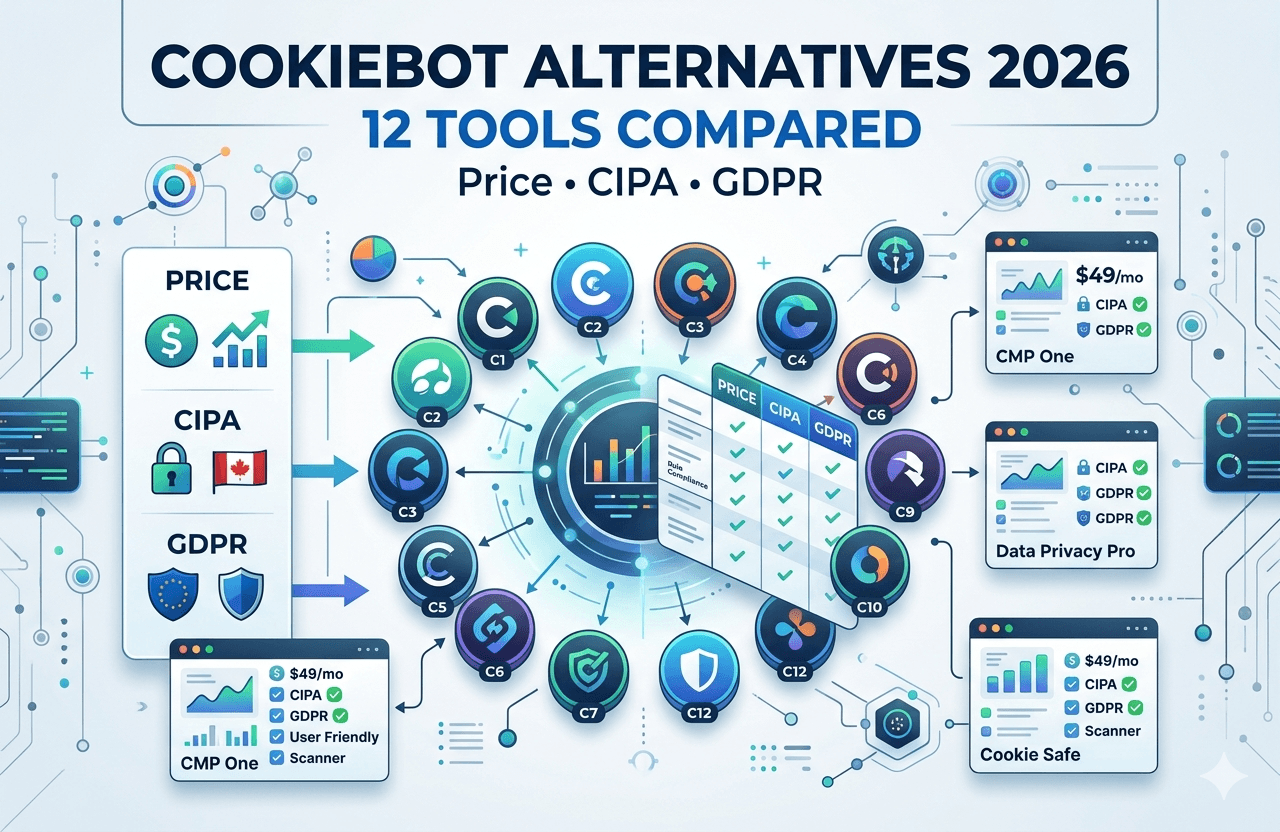
Cookiebot doubled its base pricing in August 2025 and now redirects all new signups to Usercentrics Web CMP — a different product. If you are evaluating alternatives, or building a consent stack from scratch, this is the current comparison you need: 12 tools ranked on what actually matters in 2026.
Cookiebot has been one of the most widely deployed consent management platforms in the world for years. It works, it is GDPR-certified, and for many organisations it has been a reliable set-and-forget solution. But two developments in the second half of 2025 have prompted a significant number of organisations to start shopping for alternatives.
First, Cookiebot doubled its base Premium pricing in August 2025 — from approximately €15 per domain per month to approximately €30 — with some customers on the Small plan finding themselves automatically moved to a more expensive tier. Second, Cookiebot's parent company Usercentrics began routing all new signups to Usercentrics Web CMP rather than the legacy Cookiebot product, effectively making Cookiebot a sunset product for new customers.
The result is a wave of organisations re-evaluating their consent management setup. This comparison covers 12 alternatives across the full price and feature spectrum, evaluated on the criteria that matter most in 2026: GDPR technical compliance depth, US state law coverage (particularly CIPA — the litigation wave most comparison articles still do not address), Google Consent Mode v2 implementation quality, pricing predictability, and ease of installation.
Why People Are Switching Away From Cookiebot in 2026
Understanding the specific reasons organisations are leaving Cookiebot helps frame what the alternatives need to do better. The most common reasons we see in 2026 are:
The August 2025 price doubling. Cookiebot's pricing model is based on subpage count per domain — not visitor sessions or pageviews. This means costs can increase automatically when Cookiebot's scanner detects new pages on your site, without any action on your part. The August 2025 price increase compounded this unpredictability. Customers who were paying €15/month found their bills jumping to €30 with little warning.
The Usercentrics migration. New Cookiebot signups are now directed to Usercentrics Web CMP, a different product with a different interface, different pricing model (session-based rather than page-based), and different feature set. Existing Cookiebot customers face an eventual migration with no confirmed timeline. For organisations that chose Cookiebot specifically, this creates an uncertain roadmap.
CIPA coverage. California's Invasion of Privacy Act has generated hundreds of lawsuits against websites running third-party tracking without prior consent. Cookiebot's core product is built around European privacy law — it provides opt-in consent for EU visitors but has no specific CIPA session-replay blocking logic or US state law opt-out infrastructure for the new 19-state landscape. Organisations receiving CIPA demand letters need a tool that addresses this gap.
No multi-domain bundling. Cookiebot charges full price per domain with no multi-site discount. Agencies managing 10, 20, or 50 client sites find this model expensive compared to alternatives built specifically for multi-domain deployment.
What to Look For in a Cookiebot Alternative
Not every organisation needs the same thing from a consent management platform. Before comparing tools, it is worth clarifying which of the following criteria matter most for your situation.
- Technical script blocking vs. notice-only. GDPR requires that non-essential scripts do not fire before consent is obtained — not just that a banner is displayed. Many tools still only display a notice while trackers fire in the background. Verify that any tool you consider actually blocks scripts, not just shows a banner.
- Google Consent Mode v2 completeness. All four parameters must be passed —
analytics_storage,ad_storage,ad_user_data, andad_personalization— before your GTM container loads. Many tools pass the original two parameters (v1) but not the two new v2 parameters. - US state law coverage beyond CCPA. With 19 US states now having active privacy laws and GPC signal honouring mandated in California, Colorado, Virginia, and Connecticut, a tool that only addresses GDPR and CCPA is leaving gaps.
- CIPA session-replay protection. If your site uses Hotjar, Clarity, FullStory, or Lucky Orange and serves California visitors, you need a tool that technically blocks these before consent — not just includes them in a cookie category.
- Pricing model and predictability. Subpage-based pricing (Cookiebot) can auto-upgrade without warning. Pageview-based pricing (CookieYes) can spike during traffic peaks. Flat per-domain pricing is the most predictable model for most organisations.
- Multi-domain and agency support. If you manage more than one site, per-domain pricing adds up fast. Tools built for agencies with bundled domain pricing provide significantly better value.
The 12 Cookiebot Alternatives — Detailed Reviews
ConsentPixel is built specifically for the 2026 compliance landscape — GDPR opt-in for EU visitors, 19-state US opt-out with automatic GPC signal honouring, and dedicated CIPA session-replay blocking for California visitor protection. Unlike most CMPs that have added US state law coverage as an afterthought to a GDPR-first architecture, ConsentPixel was designed from the ground up to handle both simultaneously. A single pixel handles script blocking, GCM v2 injection, consent logging, and DSAR intake with no plugin or app marketplace installation required.
CookieYes is the most widely deployed consent tool for SMB websites, with a generous free tier (5,000 pageviews/month), a well-regarded WordPress plugin, and a clean, accessible interface that non-technical users can configure in minutes. Pricing is per-domain and pageview-based — the Basic plan covers 100,000 pageviews/month at $10/domain/month. The pageview model can create cost spikes during traffic surges, with overages billed at $0.30 per 1,000 additional pageviews on lower tiers. GCM v2 is supported. CIPA coverage is limited — no specific session-replay blocking logic or dedicated CIPA posture.
Termly differentiates by bundling cookie consent management with legal policy generation — privacy policy, terms of service, refund policy — in a single tool. For small businesses that need both a compliant consent banner and legal documents, Termly avoids the need for two separate subscriptions. The consent tool itself is solid: GCM v2 compliant, Google Gold CMP Partner certified, auto-blocker included on paid plans. The free tier allows 10,000 banner views per month with quarterly scanning. Paid plans start at $10/site/month (annual) or $14/month. CIPA coverage is not a stated focus.
Usercentrics Web CMP is where Cookiebot's parent company is now directing all new signups. It is a technically solid platform — Google-certified, IAB TCF 2.2 compliant, strong EU market presence — but the pricing model is session-based rather than subpage-based, which may be more or less favourable depending on your site's page-depth patterns. The Essential entry tier covers approximately 4,500 sessions per month — relatively limited for a business site with any meaningful traffic. It has deep EU privacy law coverage and integrates well with the broader Usercentrics product ecosystem (including Cookiebot accounts eventually).
Osano is not just a consent banner — it is a broader privacy programme platform covering vendor risk management, data subject request automation, privacy assessments, and policy management alongside consent. Its US privacy law coverage is among the strongest on this list, and its team has an active posture on CIPA compliance. The price reflects the scope: $199/domain/month is 20–25x the cost of most SMB tools. For organisations that need a full privacy programme rather than just a cookie banner, Osano is worth the investment. For businesses that just need a compliant banner and CIPA protection, it is more platform than the problem requires.
OneTrust is the market leader in enterprise privacy governance. It covers consent management, data mapping, vendor risk, privacy assessments, employee training, and regulatory research in a single integrated platform. Its consent management module alone is enterprise-grade, with geo-adaptive rules, A/B testing, IAB TCF 2.2, and deep reporting. The entry-level pricing — estimated at $827/month and higher — reflects a platform built for organisations with dedicated privacy teams, not SMBs or agencies looking for a cookie banner. New customers frequently report high-pressure sales processes and a learning curve that requires professional services.
iubenda is one of the most established EU-focused compliance tools, particularly popular in Italy and Western Europe where its legal team maintains jurisdiction-specific policy templates. Like Termly, it bundles cookie consent with privacy policy and terms of service generation. The consent solution covers GDPR, ePrivacy, and CCPA — though US state law coverage beyond California is limited. GCM v2 is supported. Its cookie banner design has historically been functional rather than aesthetically polished. For European-first businesses wanting bundled compliance documentation and consent in a single affordable subscription, iubenda is a strong option.
CookieScript is frequently mentioned as a budget alternative to Cookiebot — at approximately €8/month for a single domain, it is significantly cheaper than Cookiebot's post-August 2025 pricing. It supports GCM v2, IAB TCF 2.2, and integrates with WordPress, Shopify, and Wix. The auto-blocking feature is available on paid plans. The free tier is functional for small sites. The platform's US state law coverage and CIPA posture are limited — it is primarily a GDPR and ePrivacy tool with CCPA as a secondary consideration. Support response times have been a recurring criticism in user reviews.
Complianz is a WordPress-first consent management plugin with unusually deep integration into the WP ecosystem — it automatically detects commonly used WordPress plugins and generates consent configuration recommendations based on those detections. The plugin-based approach means it works entirely within WordPress without a separate SaaS account. Pricing is straightforward: a flat annual fee rather than a monthly subscription. GDPR and CCPA coverage is solid. GCM v2 is supported. US state law coverage beyond CCPA is limited. The WordPress-only delivery model means it cannot be used on Shopify, Webflow, or other non-WordPress platforms.
Didomi is a consent management platform built specifically for the publisher and ad-tech ecosystem, with particularly deep IAB TCF 2.2 implementation for programmatic advertising compliance. If your business model depends on monetising EU visitors through programmatic ad networks that require TCF signals, Didomi is one of the most technically capable solutions available. Its preference management layer (beyond cookie consent) is also strong for organisations managing subscriber communications and marketing consent at scale. Pricing requires a sales conversation — not self-serve.
TrustArc has been in the privacy management space for over 28 years and positions itself as a full-lifecycle privacy governance, risk, and compliance (GRC) platform. Like OneTrust, it covers far more than consent management — data mapping, privacy impact assessments, vendor management, regulatory research, and incident management. The consent management module is enterprise-grade with global regulatory coverage. Pricing is enterprise-level and requires a sales engagement. For organisations replacing Cookiebot, TrustArc is almost certainly over-specification unless they simultaneously need to build a broader privacy programme.
Secure Privacy positions itself on AI-assisted cookie scanning and multi-framework regulatory coverage, supporting GDPR, CCPA, LGPD, PIPEDA, and other global frameworks from a single platform. Automatic cookie classification and consent banner generation are core features. GCM v2 is supported. The scanning and categorisation quality is generally well-regarded. Installation via Custom Code works on Wix and other SaaS platforms where plugin-based tools cannot be deployed. Pricing is accessible at entry level, though more complex configurations push into higher tiers. US state law coverage beyond CCPA is present but not a marketing focus.
Not sure if your current tool is actually blocking scripts?
Most consent banners display a notice while trackers fire anyway. ConsentPixel scans your site the way a GDPR auditor or CIPA plaintiff firm would — and shows you exactly what fires before consent.
Master Comparison Table — All 12 Tools at a Glance
| Tool | Starting Price | GDPR Script Blocking | GCM v2 (All 4) | GPC Signal | CIPA Protection | 19 US States | Multi-Domain | Self-Serve |
|---|---|---|---|---|---|---|---|---|
| ConsentPixel | $8.99/domain/mo | ✓ | ✓ | ✓ | ✓ | ✓ | ✓ Agency plans | ✓ |
| CookieYes | Free / $10/domain/mo | ✓ | ✓ | ⚠ Partial | ✗ | ⚠ Partial | ✗ Per-domain only | ✓ |
| Termly | Free / $10/site/mo | ✓ | ✓ | ⚠ Partial | ✗ | ⚠ Basic | ✗ Per-site | ✓ |
| Usercentrics | ~$7.70/mo (4.5K sessions) | ✓ | ✓ | ⚠ Partial | ✗ | ⚠ Basic | ⚠ Limited | ✓ |
| Osano | $199/domain/mo | ✓ | ✓ | ✓ | ✓ Awareness | ✓ | ⚠ Costly | ✓ |
| OneTrust | ~$827/mo (custom) | ✓ | ✓ | ✓ | ⚠ Enterprise only | ✓ | ✓ | ✗ Sales required |
| iubenda | $5.99/mo | ✓ | ✓ | ⚠ Partial | ✗ | ⚠ Partial | ✗ Per-site | ✓ |
| CookieScript | Free / ~€8/mo | ✓ | ✓ | ⚠ Partial | ✗ | ⚠ Basic | ✗ Per-domain | ✓ |
| Complianz | $59/year single site | ✓ | ✓ | ⚠ Partial | ✗ | ⚠ Partial | ✓ $199/yr unlimited | ✓ |
| Didomi | Custom | ✓ | ✓ | ⚠ Partial | ✗ | ⚠ Basic | ✓ | ✗ Sales required |
| TrustArc | Custom enterprise | ✓ | ✓ | ✓ | ⚠ Enterprise scope | ✓ | ✓ | ✗ Sales required |
| Secure Privacy | ~$10/mo | ✓ | ✓ | ⚠ Partial | ✗ | ⚠ Partial | ⚠ Limited | ✓ |
Which Tool Is Right for Your Situation?
The right Cookiebot alternative depends more on your specific situation than on any single ranking. Here is a straightforward decision framework.
If you received a CIPA demand letter or are concerned about CIPA exposure
You need a tool live within days, not weeks. Self-serve tools with same-day deployment are ConsentPixel, CookieYes, and Termly. Only ConsentPixel has a specific CIPA session-replay blocking posture. If you have Hotjar, Clarity, FullStory, or Lucky Orange running on a site with California traffic, session-replay blocking before consent is the specific technical requirement. Osano also has CIPA awareness, but at $199/domain/month, the economics work only if you need the broader privacy programme features.
If you are a web agency managing 10+ client sites
Per-domain pricing — whether Cookiebot, CookieYes, or iubenda — adds up fast across a client portfolio. ConsentPixel's Agency Lite plan at $99.99/month covers 10 domains with white-label branding and a client portal. Complianz's unlimited WordPress plan at $199/year is an extraordinary value if all your clients are on WordPress and your compliance needs are primarily GDPR and CCPA. For agencies needing robust US state law coverage across client sites, ConsentPixel is currently the most purpose-built option.
If you are a single-site SMB primarily serving the EU
CookieYes, Termly, iubenda, and CookieScript are all solid options at a lower price point than Cookiebot's post-increase pricing. CookieYes has the strongest brand trust and WordPress ecosystem. iubenda is the strongest choice for EU-specific policy documentation needs. Termly is best if you need both consent management and legal policy generation bundled together.
If you are migrating from Cookiebot specifically
Usercentrics Web CMP is the intended migration path — but it uses a different pricing model and interface that requires a fresh setup. If you are happy with Cookiebot's feature set but not with the new pricing, CookieScript is the most direct like-for-like replacement at approximately €8/month. If you want to upgrade your US law compliance simultaneously, ConsentPixel is the most complete migration that also closes the CIPA gap Cookiebot never addressed.
The CIPA Dimension — What Most Comparison Articles Miss
Virtually every Cookiebot alternative comparison article in 2026 evaluates tools on GDPR compliance, GCM v2 support, pricing, and UX. Almost none cover CIPA — the California Invasion of Privacy Act — which has become the most actively litigated privacy law for US websites.
CIPA's pen register provision creates $5,000 per-visitor liability for any website running session-replay tools (Hotjar, Clarity, Lucky Orange, FullStory) on California visitors without prior consent. Courts in 2025–2026 have confirmed that the pen register theory applies to web tracking, and that even having a consent banner does not protect a site where trackers fire before the banner renders. The Garcia v. AEG decision confirmed this explicitly: a site with a consent banner still lost the CIPA pen register claim because its third-party cookies activated before the visitor had any opportunity to interact with the banner.
Most CMPs were built for GDPR and have retrofitted US compliance as an afterthought. Their session-replay blocking — where it exists at all — applies the same logic as analytics cookie blocking, with no specific understanding of CIPA's pen register theory or the checkout-page risk elevation confirmed in the Bloomingdale's and Nike FullStory cases.
When evaluating a Cookiebot alternative, the CIPA question to ask is not "does this tool include CCPA?" — it is "does this tool technically block session-replay scripts before the banner renders on California visitors' page loads, and does it block them on checkout and form pages specifically?" Only a handful of tools on this list have a clear answer to that question.
The Verdict — Switching from Cookiebot in 2026
If you are primarily leaving Cookiebot because of the August 2025 price increase and your compliance needs are mainly GDPR and CCPA for a single EU-focused website, CookieYes, Termly, or CookieScript are all viable, affordable replacements with a similar technical feature set at lower cost.
If you manage multiple client sites as an agency, the economics of per-domain pricing favour ConsentPixel's agency plans or Complianz's unlimited WordPress plan over any of the major per-domain alternatives.
If you serve US visitors — particularly if your site runs any session-replay tool and has California traffic — the CIPA dimension should drive your decision more than any other factor. A CMP that looks compliant but fires session-replay before the banner renders is not protecting you from the litigation risk that is currently generating hundreds of demand letters per month. ConsentPixel is the only tool in this comparison built specifically to address the CIPA technical requirements alongside GDPR and 19-state US law coverage from a single pixel.
Start ConsentPixel Free 14-Day Trial — No Credit Card →