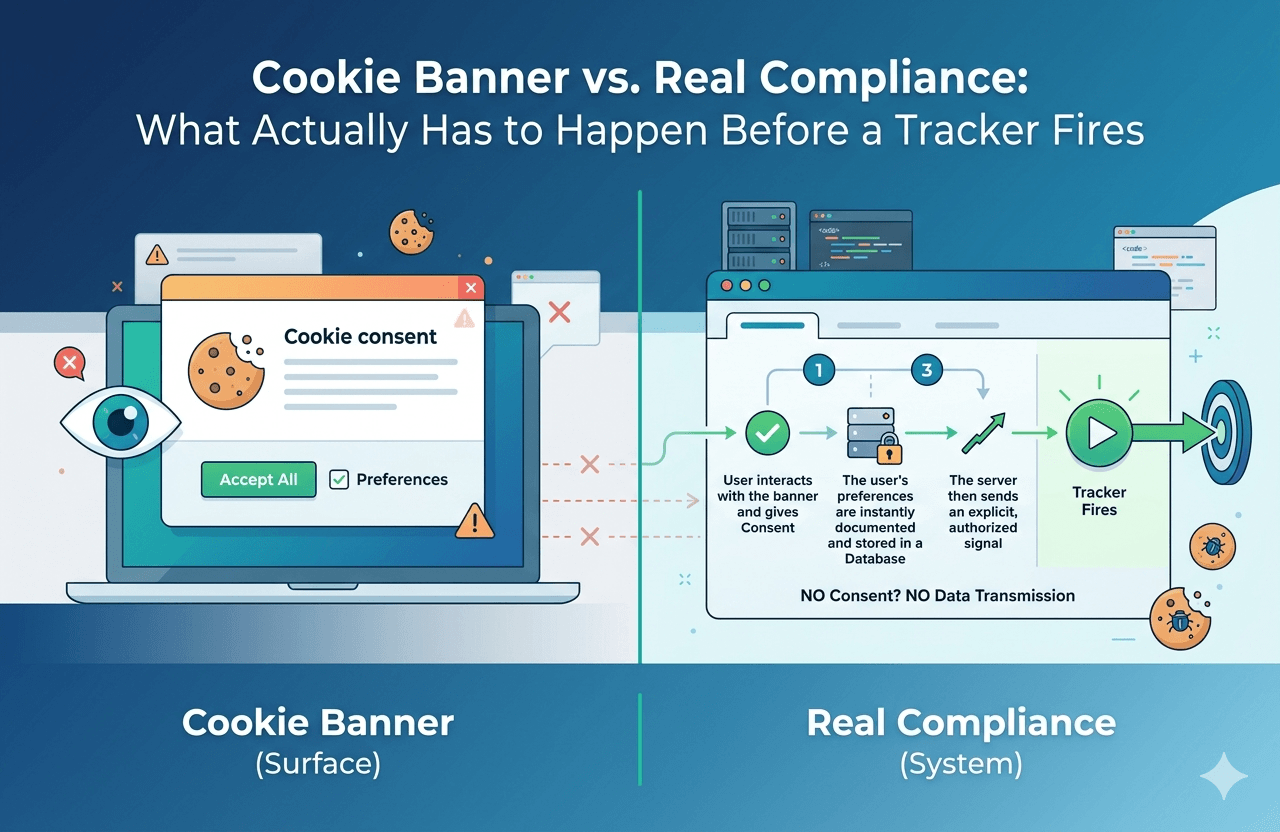
Walk into any website privacy review today and the first instinct is to ask, "Is there a cookie banner?" It's the wrong question. A banner tells you a site intended to do something. It tells you nothing about what the browser actually did — and in a CIPA-era review, what the browser actually did is the entire case.
The better question is precise: what fired in the browser, on which page, before the visitor consented? Everything that matters for compliance, and everything that matters as evidence, lives in the answer to that.
Key takeaways
- A cookie banner is a statement of intent, not evidence of compliance.
- A real review examines browser behavior — third-party requests, pixel timing, per-page consent state — not just whether a tag exists.
- The decisive fact is timing relative to consent: did the tracker fire before the visitor agreed?
- Compliance is shifting from one-off scans and screenshots to a continuous, page-scoped evidence trail that builds itself.
Why a banner isn't evidence
A cookie banner is a control you put on a page. Whether it actually works is a separate question entirely — and a surprisingly common failure is the banner that displays a tidy notice while the trackers underneath fire regardless of what the visitor clicks. To a casual look, that site appears compliant. To a browser-level review, it's wide open.
This is why a screenshot of a banner proves very little. It captures the intent, not the behavior. The behavior is in the network: the requests that left the browser, when they left, and whether a consent choice had been made first. A site can have an immaculate banner and still be leaking data to third parties before anyone consents to anything.
What a real tracking review actually examines
Once you stop asking "is there a banner?" and start asking "what happened?", the review changes shape. Instead of a yes/no checkbox, you're looking at the actual evidence the browser produces as a page loads:
- Third-party requests — which outside parties the page contacted, and what it sent them.
- Tracking pixels and tags — not just that they exist, but whether they executed.
- Request timing — the single most important signal: did the request fire before or after the consent choice?
- Consent state, per page — what the visitor had agreed to at the moment each request fired.
- Per-page coverage — whether protection that exists on the homepage actually exists on the checkout page, the landing page, the blog.
A standard cookie scanner can tell you a tag is present. That's a useful start, but it doesn't answer the question that determines exposure. "A Meta Pixel exists on this page" and "the Meta Pixel fired and transmitted data before the visitor consented" are completely different findings — and only the second one is what a CIPA demand letter is built on.
The evidence chain
For legal, compliance, and engineering teams to review a site with facts instead of assumptions, the behavior needs to be captured as an ordered chain — a record of what happened, in sequence, that anyone can follow:
Page loads
The visitor arrives and the page begins to render.
Consent appears
The consent interface is shown before non-essential tracking runs.
Choice is made
The visitor accepts or declines — a recorded decision.
Behavior is captured
Trackers are blocked or allowed to fire, according to that choice.
Record is kept
The decision is logged with a timestamp and the page it happened on.
When that chain exists and is intact, a review is fast and factual: you can see, page by page, that tracking waited for consent and that the decision was recorded. When the chain is missing — when all you have is a screenshot of a banner and an assumption that the rest of the site behaves the same way — every gap becomes a question mark, and question marks are what turn into liability.
Prevention beats forensics
Here's the shift worth paying attention to. Much of the privacy-review world is organized around forensics — reconstructing, after a complaint arrives, what a site did to a visitor weeks or months ago. That work is valuable, and sometimes unavoidable. But it starts from a position of disadvantage: something already went wrong, and now you're assembling the record of it.
There's a stronger place to stand. If your site is built so that trackers are blocked until consent on every page, and the consent decision is recorded as it happens, then the evidence trail isn't something you reconstruct under pressure — it's something your stack produces continuously, by default. You're not gathering proof of a problem; you're maintaining proof that there wasn't one.
| Forensic approach | Continuous-evidence approach | |
|---|---|---|
| When it happens | After a complaint or letter | Continuously, in real time |
| Starting position | Something already went wrong | Prevention is already in place |
| Coverage | Whatever pages get reviewed | Every page, every day |
| The evidence | Reconstructed under pressure | Builds itself as you go |
What does your site actually do before consent?
Scan it free and see which trackers fire before a visitor agrees — in about 10 seconds.
What "evidence by default" looks like
This is the model ConsentPixel is built around. Rather than treating consent as a banner you install and forget, the product treats it as a continuous, recorded state:
- Trackers are blocked until consent — on every page, so the "before consent" window that drives exposure is closed by default rather than discovered later.
- Coverage is monitored continuously — the whole site is checked, so a new page that's missing protection is caught in days, not surfaced in a lawsuit. (See Coverage Monitor.)
- Consent is logged, page by page — every decision is recorded with a timestamp and the exact page it was captured on, so the record reflects what actually happened where it happened, and can't be misrepresented as blanket site-wide consent.
The result is that audit-readiness stops being a scramble. When a question comes — from your own compliance team, a partner, or counsel responding to a letter — the answer isn't "let us reconstruct it." It's "here's the record." That's the direction privacy compliance is heading: less guesswork, more evidence, and clearer collaboration between the legal, compliance, and engineering teams who all need to trust the same set of facts.
Frequently asked questions
No. A cookie banner shows intent, not evidence. What matters in a privacy or CIPA review is what actually happened in the browser — which third-party requests fired, on which page, and whether they fired before or after the visitor consented. A banner that displays a notice while trackers fire underneath provides no protection and no useful evidence.
Beyond whether a banner exists, a thorough review examines the actual browser behavior: third-party network requests, tracking pixels, request timing relative to the consent choice, the consent state on each page, and per-page coverage. The central question is what fired before consent was given, because that's the pattern that creates exposure.
An evidence chain is the ordered record of what a website did: the page loaded, the consent interface appeared, the visitor made a choice, trackers were either blocked or fired, and that decision was recorded with a timestamp and the page it occurred on. A clear evidence chain lets legal, compliance, and engineering teams review behavior with facts rather than assumptions.
The shift is from one-off scans and screenshots toward continuous, structured evidence. Instead of checking a homepage once and assuming the rest of the site matches, modern compliance monitors every page continuously and produces a page-scoped, timestamped consent record as it goes — so the evidence trail builds itself rather than being reconstructed after a complaint.
The bottom line
A cookie banner answers a question almost no one should be asking. The question that decides a privacy review — and a CIPA claim — is what fired in the browser, on which page, before the visitor consented, and whether you can show it. You can answer that defensively, by reconstructing the past after a letter arrives. Or you can answer it by default, with a stack that blocks trackers until consent, watches every page, and records each decision as it happens. The second path is less work, less risk, and a far better place to stand when someone asks you to prove it.
See what your site does before consent
ConsentPixel blocks trackers until consent, monitors every page, and keeps a page-scoped record of every decision — from a single pixel. Find out where your site stands in about 10 seconds.
Scan your site free