Google Signals Just Lost Control of Your Ad Data — What the June 15, 2026 Change Means
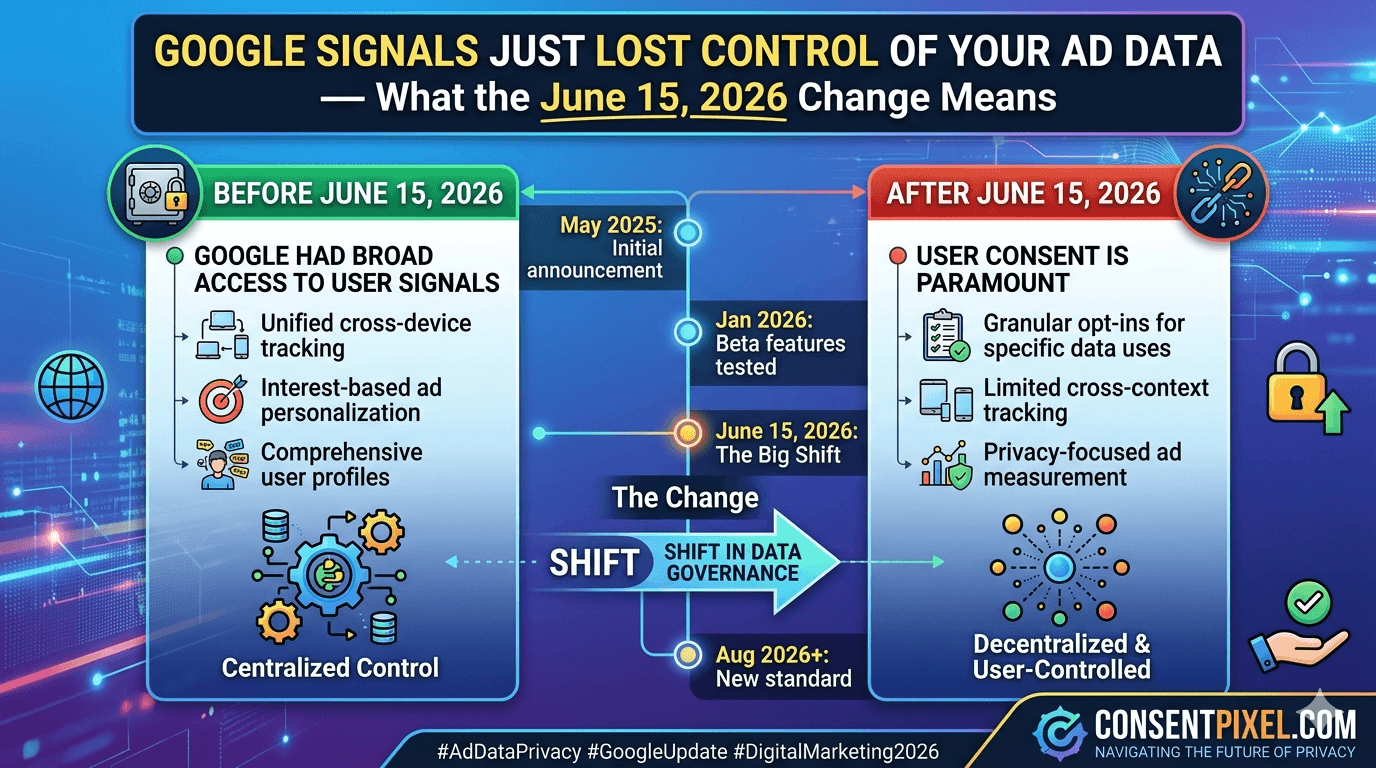
As of June 15, the Google Signals toggle in GA4 no longer governs what flows to Google Ads. Consent Mode's ad_storage is now the only switch that matters — which means your cookie banner just became load-bearing for both your compliance and your remarketing.
In this article
If your remarketing audiences or Smart Bidding performance start looking strange over the next couple of weeks, this is probably why. On June 15, 2026, Google quietly rewired how advertising data moves between Google Analytics and Google Ads — and the change is the kind that breaks tracking without throwing a single error in your dashboard.
The short version: a setting that used to act as a safety gate on ad-data collection has been switched off, and the entire job now falls to your Consent Mode implementation. For most sites, that means the cookie banner — and whether it's configured correctly — is now the single thing standing between you and a collapsing ad-data feed. Here's what changed, why it matters, and the specific checks to run now.
What just happened
Google announced this back in mid-April 2026 through a Google Analytics Help Center post and emails to customers with linked Analytics and Ads accounts. The headline change took effect on June 15: Google Signals is no longer a co-controller of advertising data collection. That authority now sits entirely with Consent Mode's ad_storage parameter, managed on the Google Ads side.
This affects essentially everyone running paid media, because linking a Google Analytics property to a Google Ads account is the standard configuration. If your GA4 property feeds audiences or conversions to Ads — and most do — you're in scope whether you noticed the email or not.
What actually changed (before vs after)
Google Signals isn't being deleted. It's being demoted. Previously it did two jobs: it enabled cross-device, signed-in reporting and it acted as a gate on whether Google Ads received advertising cookies and identifiers from your site. After June 15, it keeps only the first job. Its sole remaining purpose is associating sessions with signed-in users for behavioral and demographic reporting inside GA4. It now carries no weight over what reaches Google Ads.
The mental model that makes this click: it used to be two locks on one door. Both Google Signals and Consent Mode had to permit the flow for ad data to pass. Now there's only one lock — ad_storage — and if it isn't open, nothing gets through, no matter what your GA4 settings say.
Why you'll feel it as a silent drop
This is the part that catches teams off guard. There's no error message, no broken tag, no red flag in GA4. If your consent banner wasn't already passing accurate ad_storage signals, the data simply stops flowing for the users who didn't explicitly grant it — and your remarketing lists quietly contract while Smart Bidding loses signal.
Sites that previously leaned on Google Signals' cross-device reach to pad their audiences are most exposed. Those audiences will shrink to include only users who explicitly granted ad_storage. A store that never audited its consent implementation can watch remarketing lists thin out and bidding performance soften with nothing in the dashboard explaining why.
If you ran a baseline report before June 15, compare it against the same report now. A meaningful drop in Google Ads conversion counts, GA4 audience sizes, or remarketing list sizes points straight at a Consent Mode implementation that was doing less than you assumed — Google Signals had been quietly covering the gap.
The counterintuitive twist
Here's the wrinkle most coverage misses, and it matters for how you think about the change. The effect isn't only "less data." For some sites, it's more.
If you had previously turned Google Signals off as a way to limit ad-data flow — a common, low-friction privacy move — that lever no longer does anything for Ads collection. After June 15, if a user grants ad_storage through your banner, ad data can flow to your linked Ads account even though Signals is off. In other words, switching Signals off used to suppress some ad data; now only the consent signal decides. Brands that relied on the Signals toggle as a quiet privacy control could actually see more ad-linked data than before, purely because the toggle they trusted no longer holds back anything.
That's the real lesson of this change: informal, settings-based privacy controls are being replaced by one explicit consent signal. Whether that results in less data or more depends entirely on what your banner is telling Google — which is exactly why getting the banner right is no longer optional.
The three bundled changes
The June 15 demotion is the first and only confirmed-date piece. Google has signaled two more changes for later in 2026 without firm dates yet:
The second change consolidates ads personalization control under the ad_personalization Consent Mode parameter, replacing the layered GA4 settings (account, property, Ads-link, and event level) that currently govern it. The third concerns IP addresses: Analytics tags will keep collecting them, but Google will encrypt them before forwarding to linked Ads accounts, with what happens next governed by Google Ads account settings rather than anything in Analytics. Both are directional announcements — treat the timing as pending, not set.
Why this is really a consent-correctness story
It's tempting to read this as a pure performance-marketing problem: "configure your CMP so you don't lose audiences." That's half the picture, and it's the less important half.
The deeper shift is that consent is no longer a privacy detail tucked into a banner plugin — it's now the source of truth for what your ad stack can and can't do. After June 15, the same signal that keeps you compliant is the signal that determines whether your remarketing works. Get it right and both line up. Get it wrong and you lose on one side or the other: either you under-collect and your campaigns starve, or you over-collect relative to what users actually consented to and you carry the compliance exposure.
This is why the framing matters. The goal isn't to configure your banner to maximize data flow — it's to make the banner accurate, so the right data flows when consent genuinely exists and nothing flows when it doesn't. A consent layer that fires ad_storage: granted for users who didn't actually agree isn't a clever performance hack; it's the exact gap that turns into a CIPA or CCPA problem. Accuracy is the whole game now.
One easily-missed consequence: any privacy policy or cookie notice that names Google Signals as your mechanism for controlling ad data is now inaccurate. Those references should be updated to point to Consent Mode and ad_storage — and material-change disclosure obligations are worth raising with counsel.
What to check now
Whether or not you've already seen a dip, here's the practical audit:
- Confirm your CMP actually fires
ad_storagecorrectly. When a user grants consent, the granted signal must reach Google Ads; when they decline, it must not. Test both paths, not just the accept path. - Pull a before/after comparison. If you captured a baseline before June 15, compare Google Ads conversion counts, GA4 audience sizes, and remarketing list sizes against today. If you didn't, snapshot now so you have a reference point as the change settles.
- Review Google Ads account-level settings. After the cutover, account-level settings for personalization, customer data, and IP handling carry more weight than anything inside Analytics. Make sure they match your intended setup for every market you serve.
- Check that decline actually blocks. The flip side of "don't lose data" is "don't collect data you shouldn't." Verify that a user who declines isn't having ad identifiers collected anyway — that's the compliance-exposure side of the same coin.
- Update your privacy documentation. Replace any reference to Google Signals as an ad-data control with Consent Mode /
ad_storage.
How ConsentPixel handles it
This change rewards exactly the thing ConsentPixel — Privacy · Verified is built to do: pass accurate Consent Mode v2 signals tied to real consent state. Because the pixel already implements Google Consent Mode v2, the ad_storage and ad_personalization signals it sends reflect what each visitor actually chose — granted when they consent, denied when they don't, with no tracking firing before that choice is made.
That correctness is now doing double duty. It's what keeps you defensible under CIPA and CCPA — no interception before consent — and, after June 15, it's also what keeps your legitimate, consented ad data flowing cleanly to Google Ads instead of silently leaking away. And because the pixel keeps verifiable, page-scoped consent records, you have evidence of what each visitor chose and what fired as a result — useful whether the question comes from a regulator or from a marketer asking why an audience changed size.
The point isn't to help you collect more. It's to make sure the signal Google now relies on is honest — which, after this change, is the only way to be both compliant and effective at the same time.
The bottom line
On June 15, 2026, Google Signals stopped gatekeeping ad data and handed the entire job to Consent Mode's ad_storage. The change is silent — no errors, just audiences and bidding signal quietly shifting based on what your banner tells Google. For sites that trusted the Signals toggle as a privacy control, the effect can even run the other way: more ad data, not less. Either way, the lesson is the same. Your consent layer is now the single source of truth for your ad stack, which means an accurate banner isn't just a compliance nicety anymore — it's the thing holding your remarketing together. Audit it now, and make sure the signal it sends is the truth.
Frequently asked questions
What changed with Google Signals on June 15, 2026?
Google Signals stopped acting as a co-controller of advertising data collection. Consent Mode's ad_storage parameter, managed within Google Ads, became the single authority over whether Google Ads cookies and identifiers are collected from your GA4 property. Google Signals now only controls signed-in user association for behavioral and demographic reporting inside GA4.
Will this reduce the personal data sent to Google Ads?
It depends on your setup — and it can go either way. For sites relying on a properly configured banner, only consented data flows, which may shrink audiences built on Google Signals' cross-device reach. But sites that had turned Google Signals off to limit data flow may now see more ad-linked data, because that toggle no longer holds anything back; only the ad_storage consent signal decides.
Why are my remarketing audiences shrinking with no error showing?
Because the change fails silently. If your CMP wasn't passing accurate ad_storage signals, data stops flowing for users who didn't explicitly grant it, and Google Signals is no longer there to cover the gap. Audiences contract and Smart Bidding loses signal without any dashboard error. Compare a pre-June-15 baseline against current numbers to confirm.
Does this affect me if I'm not in the EU?
Yes. The change applies to any organization with a Google Analytics property linked to Google Ads, which is the standard configuration regardless of region. Consent Mode v2 has been mandatory for EEA/UK traffic since 2024, but the June 15 restructuring of how ad_storage governs data flow affects linked accounts broadly.
What should I check right now?
Confirm your CMP fires ad_storage correctly on both accept and decline; pull a before/after comparison of conversions, audience sizes, and remarketing lists; review your Google Ads account-level settings, which now outweigh GA4 toggles; verify that declining actually blocks collection; and update any privacy documentation that still names Google Signals as your ad-data control.
Do I need to update my privacy policy?
Likely yes. Any privacy policy or cookie notice that cites Google Signals as the mechanism controlling advertising data became inaccurate after June 15. Update those references to point to Consent Mode and ad_storage, and consider raising material-change disclosure obligations with counsel. This article is informational and not legal advice.
Make sure the signal Google relies on is the truth
ConsentPixel — Privacy · Verified passes accurate Consent Mode v2 signals tied to real consent — blocking trackers before consent and keeping verifiable records. Compliant and effective, from one pixel.
Scan my site free