How Web Agencies Can Offer Privacy Compliance as a Monthly Retainer Service
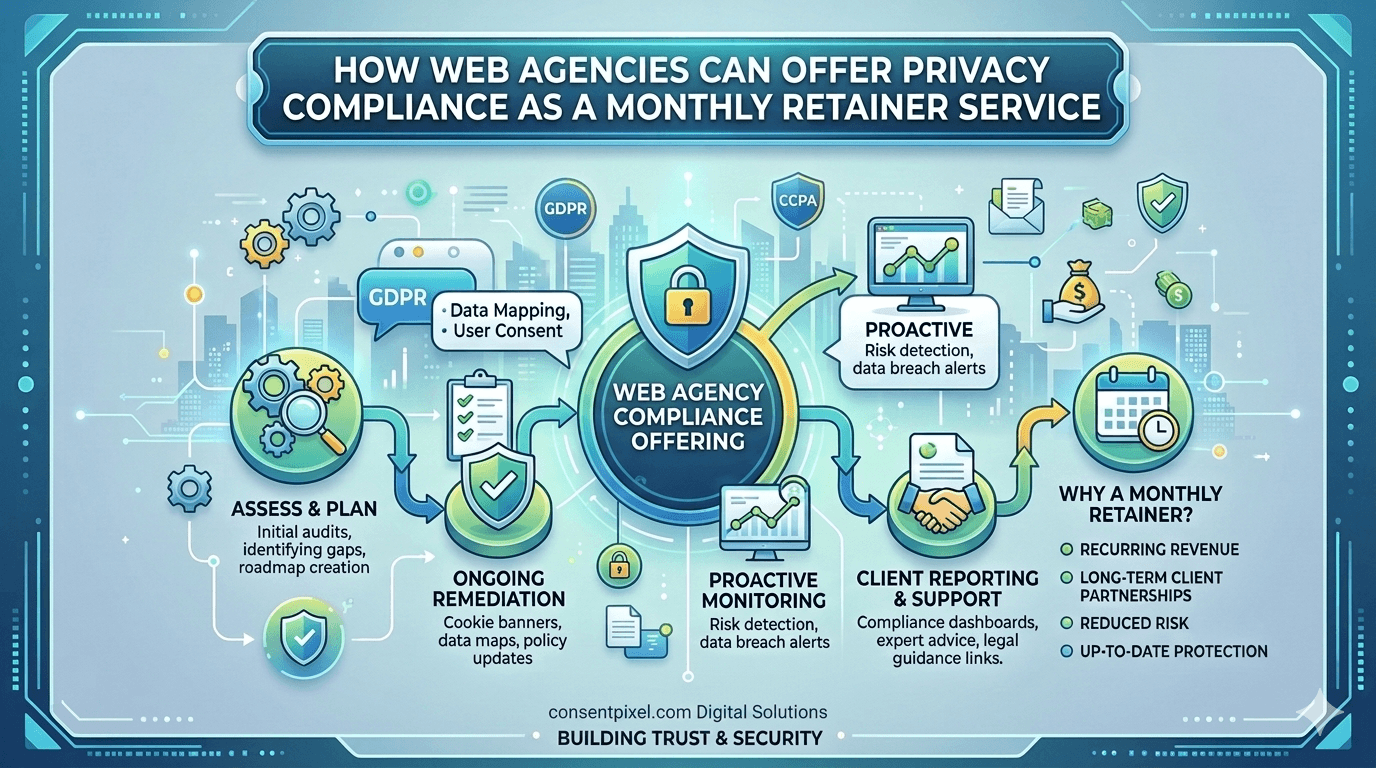
Privacy compliance is one of the most underserved monthly retainer opportunities in the agency market. Your clients need it, the law increasingly demands it, and most of them have no idea where to start. Here is exactly how to build it, price it, and deliver it in a way that deepens trust and generates referrals.
- Why Privacy Compliance Is the Retainer Opportunity Agencies Are Missing
- What a Privacy Compliance Retainer Should Include
- How to Price It — Three Tier Model
- How to Sell It to Existing and New Clients
- Delivering It Without Becoming a Privacy Law Firm
- The Monthly Report That Keeps Clients Renewing
- Turning Compliance Into Referrals
- Frequently Asked Questions
Web agencies are increasingly being asked about privacy compliance by clients who have received demand letters, noticed GDPR fines in the news, or simply had a competitor mention that their website uses session-replay without consent. The question most agencies are not yet prepared to answer is: "Can you handle this for us on an ongoing basis?"
The answer should be yes. Privacy compliance is not a one-time project — it is an ongoing operational need. Privacy laws change. New trackers get installed when plugins or apps update. Google Consent Mode requirements evolve. The Global Privacy Control becomes mandatory in another state. A compliance configuration that was accurate in January needs reviewing by June. That recurring nature is exactly what makes privacy compliance a natural fit for a monthly retainer structure.
This guide is for agency owners and account managers who want to build a privacy compliance retainer offering — not as a theoretical service line, but as a concrete, deliverable, scalable product that generates predictable monthly revenue and makes clients feel genuinely looked after.
Why Privacy Compliance Is the Retainer Opportunity Agencies Are Missing
Most agencies that offer monthly retainers focus on SEO, content, paid media, or maintenance. These are competitive, margin-compressed categories where clients shop on price and churn when results plateau. Privacy compliance is different in three important ways.
It is driven by legal obligation, not optional value
An SEO retainer is a discretionary investment — a client can pause it when budgets tighten without immediate consequences. A privacy compliance retainer is tied to legal exposure. A client who stops paying for SEO loses rankings. A client who stops maintaining their consent configuration faces regulatory fines and — more immediately for US eCommerce clients — CIPA lawsuit exposure of $5,000 per California visitor from unmanaged session-replay tools. Legal obligation creates stickier retainers than value perception alone.
The problem is perpetually self-renewing
Every new plugin your client installs might introduce a new tracker. Every Google Analytics update changes what configuration their Consent Mode v2 setup needs. Every new US state that enacts a privacy law potentially adds to your client's compliance scope. Privacy compliance requires the same kind of ongoing monitoring and adjustment that makes SEO a retainer rather than a one-time project — but with higher stakes and less client inclination to DIY it.
Your clients genuinely do not know where to start
Ask a typical SMB owner what CIPA is. Ask them whether their WooCommerce checkout page runs Hotjar before consent is given. Ask them whether their Google Ads conversion tags pass all four Google Consent Mode v2 parameters to their EU visitors. The answer to all three will almost certainly be a blank stare. That gap between what the law requires and what your clients know is your service opportunity — and because you already manage their website, you are the logical trusted advisor to fill it.
What a Privacy Compliance Retainer Should Include
The most common mistake agencies make when trying to launch a compliance retainer is overcomplicating the scope. Privacy compliance does not require legal expertise to deliver at the technical level — and that is the level you are operating at. Your job is to implement and maintain the technical infrastructure of consent management, not to give legal opinions about whether your client's data practices are lawful.
A well-structured agency privacy compliance retainer has two layers: a one-time setup component in month one, and a recurring monthly maintenance component thereafter.
Month one — setup and deployment
Site scan and tracker audit
Full inventory of every third-party script, cookie, and tracking pixel on the client's site — categorised by risk level and the specific privacy laws each one triggers.
Consent banner deployment
Installation of a technically blocking consent management platform — not a notice overlay. GDPR opt-in for EU visitors, CCPA opt-out for US visitors, GPC signal detection where mandated.
Google Consent Mode v2 configuration
All four GCM v2 parameters configured and verified before any Google tag loads. Protects conversion measurement for EU and UK visitors and preserves smart bidding signals.
Privacy policy review and update
Review of the client's existing privacy policy against their actual tracker stack — flagging missing disclosures and recommending specific language updates to cover all identified trackers.
Consumer rights intake form
Deployment of a DSAR (data subject request) intake form embedded in the client's privacy policy page. Routes requests to a monitored inbox with deadline tracking.
Compliance verification report
A documented pass/fail check confirming: no scripts fire before consent, GCM v2 is passing, GPC is honoured where required, and consent events are being logged.
Ongoing monthly — maintenance and monitoring
- Monthly tracker rescan — identifies new scripts introduced by plugin updates, new app integrations, or code changes the client made without telling you
- Consent log review — spot-check that consent events are being logged correctly and that the audit trail is clean
- DSAR monitoring — ensure any incoming data subject requests are flagged and within their response window
- Law change alerts — notification when a new US state privacy law becomes relevant to the client's traffic or a regulation they are already covered under is amended
- Monthly compliance report — a one-page summary delivered to the client showing consent rates, opt-out percentages, new trackers found, and overall compliance status
How to Price It — Three-Tier Model
Privacy compliance retainers work well as a three-tier offering. Tiering lets clients self-select based on their site complexity and risk profile, and gives you a natural upgrade path as clients' needs grow. Using a white-label consent management platform as your delivery backbone, the margin structure is highly attractive.
| Tier | Best For | What's Included | Your Price | Platform Cost | Margin |
|---|---|---|---|---|---|
| Essential | Simple brochure sites, blogs, low-traffic | Consent banner, basic script blocking, monthly scan, quarterly report | $99/mo | $8.99/mo | 91% gross |
| Professional | Small business sites, lead gen, Google Ads | Everything in Essential + GCM v2, GPC detection, monthly report, DSAR form | $179/mo | $8.99/mo | 95% gross |
| Commerce | eCommerce, WooCommerce, Shopify stores | Everything in Professional + checkout CIPA protection, DSAR handling, 30-day response SLA, law change alerts | $299/mo | $29.99/mo | 90% gross |
The revenue picture at modest scale is compelling. Here is what a ten-client compliance book of business looks like:
ConsentPixel has an agency plan built for this model
Agency Lite covers 10 domains at $99.99/mo. Agency Pro covers 25 domains at $199.99/mo. White-label branding, client portal access, and bulk domain management included.
How to Sell It to Existing and New Clients
The most effective way to introduce a privacy compliance retainer to existing clients is not a service announcement email. It is a personalised finding. Run a scan of each client's site, identify one specific compliance gap — a session-replay tool loading before consent on their checkout page, a missing GCM v2 implementation, a GPC signal being ignored — and email them about that specific issue.
This approach works for three reasons. First, it is about their site, not about a service you want to sell. Second, it demonstrates that you are already monitoring their interests proactively. Third, it gives the client a concrete reason to act rather than a vague awareness of a distant risk.
Here is a template that converts well for existing clients:
For new client pitches, frame privacy compliance as a natural part of your website delivery process. Every new site you build should include a compliance setup component — it positions your agency as thorough and professional, protects the client from day one, and creates an immediate retainer conversation at handoff.
Delivering It Without Becoming a Privacy Law Firm
The concern most agencies raise when considering a compliance offering is: "We are not lawyers — what if we get something wrong?" This is a legitimate concern worth addressing clearly, because the answer determines whether you can comfortably build this service.
The distinction between technical compliance implementation and legal compliance advice is meaningful and defensible. Your agency is doing the former. You are deploying a consent management platform, configuring it to match the regulatory requirements it was built to address, and maintaining it over time. You are not advising clients on whether their overall data practices comply with the law, whether a specific business practice is lawful under GDPR, or what they should do if they receive a regulatory investigation.
This distinction should be clearly stated in your service agreement. A simple clause works well:
Beyond the legal distinction, the practical reality is that a well-configured consent management platform handles the regulatory logic for you. The platform is built by privacy specialists who track regulatory changes. It knows that Colorado requires automatic GPC signal honouring. It knows that GDPR requires opt-in while CCPA requires opt-out. It knows that Google Consent Mode v2 needs all four parameters before GTM loads. Your job is to configure, maintain, and monitor it — not to independently interpret the law.
Use a platform that builds compliance in — not one you configure from scratch
A consent management platform with geo-targeting baked in, GPC detection built in, and GCM v2 handled automatically dramatically reduces your configuration burden and your risk of misconfiguration. You are applying the platform's regulatory intelligence, not creating your own.
Document your configuration decisions
For each client, maintain a brief record of what was configured, why, and when. This is your service record and your protection if a client ever questions whether their configuration was set up correctly. A one-page setup summary per client is sufficient.
Be clear about what you do not cover
Your retainer covers the technical consent layer — the banner, script blocking, logging, and GPC detection. It does not cover the client's broader data practices, their employee data handling, their data retention policies, or their responses to legal proceedings. Being explicit about this scope keeps expectations clear and protects your agency from overreach.
Build a referral relationship with a privacy attorney
Find one privacy or data protection attorney in your market and develop a referral relationship. When a client needs legal advice that goes beyond your technical scope — a GDPR compliance audit, a data breach response, a regulatory inquiry — you refer them to your attorney contact. This makes you more valuable, not less. Clients appreciate an agency that knows its lane and has the right connections.
The Monthly Report That Keeps Clients Renewing
The single most effective retention tool for a compliance retainer is a monthly report that makes the value of your service tangible. Privacy compliance is invisible when it is working — clients do not feel the CIPA lawsuit that did not happen. Your report makes the protection concrete.
A good monthly compliance report covers five things — and takes under an hour to produce once you have a template:
- Compliance status summary — a simple green/amber/red status for each compliance area (GDPR, CCPA, GPC, consent logging). Most months it is all green, which is exactly the reassurance clients want.
- Consent metrics — how many consent events were recorded, what the opt-in rate was for analytics and marketing categories, and what percentage of visitors opted out or used GPC. These numbers make compliance feel real and give clients data they can actually use.
- New trackers found — any scripts detected this month that were not present last month. Even a finding of zero trackers changed demonstrates that monitoring is happening.
- DSARs received and status — any data subject rights requests received and whether they are within their response window. For most SMB clients, this is zero most months — but knowing the system is in place is valuable.
- One regulatory update of relevance — a single paragraph on a privacy law development relevant to the client's situation. This does not need to be comprehensive — it just needs to demonstrate that you are monitoring the regulatory environment on their behalf.
The report itself should be brief, visually clean, and client-friendly — not a technical document. A one or two page PDF in your agency's branding, delivered by email on the same day each month, with a clear summary line in the email subject. Clients do not read 15-page compliance reports. They read a summary that tells them they are protected.
Turning Compliance Into Referrals
Privacy compliance is an unusually strong referral driver for one simple reason: it is a problem every business owner knows other business owners are facing. When a client mentions to a peer that their agency handles their privacy compliance — especially in the context of the CIPA lawsuit wave that has targeted small businesses and eCommerce stores — that peer immediately wonders whether their own site is exposed.
There are three ways to turn your compliance retainer clients into active referrers.
Make compliance a visible credential
Work with clients to add a "Privacy Verified" or "Consent Managed" badge to their website footer. ConsentPixel's trust badge serves exactly this purpose — it signals to visitors that the site takes privacy seriously, and it signals to peers and business connections that the client's agency handles this layer of their web presence. Visible credentials generate questions from peers, which generate referrals.
Educate clients so they can educate their networks
A client who understands why their compliance setup matters is far more likely to mention it in conversation than one who just pays a monthly invoice without understanding the value. Send a brief "what your compliance setup protects you from" summary in month one — covering CIPA exposure, GDPR fines, and what GPC means for their ad campaigns. Clients who understand the protection become advocates for it.
Create a referral incentive specifically for compliance
Offer existing compliance retainer clients a one-month credit for every new client they refer who signs up for a compliance retainer. The incentive is modest enough to be affordable and large enough to be memorable — and it frames the referral as a favour to their network ("I'm saving you from a lawsuit") rather than a commercial transaction.
Frequently Asked Questions
Privacy compliance is the retainer that earns trust before it earns revenue
The agencies that add privacy compliance to their service offering in the next 12 months will have a meaningful advantage over those that wait. The regulatory environment is only tightening. The CIPA litigation wave is still building. The number of US states with active privacy laws has nearly doubled in two years. Every client you manage has compliance exposure you could be helping them address — and be paid a fair monthly retainer to do so.
The margin is there. The need is there. The trust-building value is unlike any other retainer service. What is missing for most agencies is a simple, reliable delivery platform and a process for introducing it to clients. ConsentPixel — Privacy · Verified is built specifically for agency delivery — white-label branding, multi-domain management, client portal access, and consent logs that feed directly into your monthly reporting.
Explore the ConsentPixel Agency Programme →