ConsentPixel – Privacy · Verified

CookieYes Alternatives 2026 - 10 Tools Compared (Price, CIPA, GDPR)
Alternatives

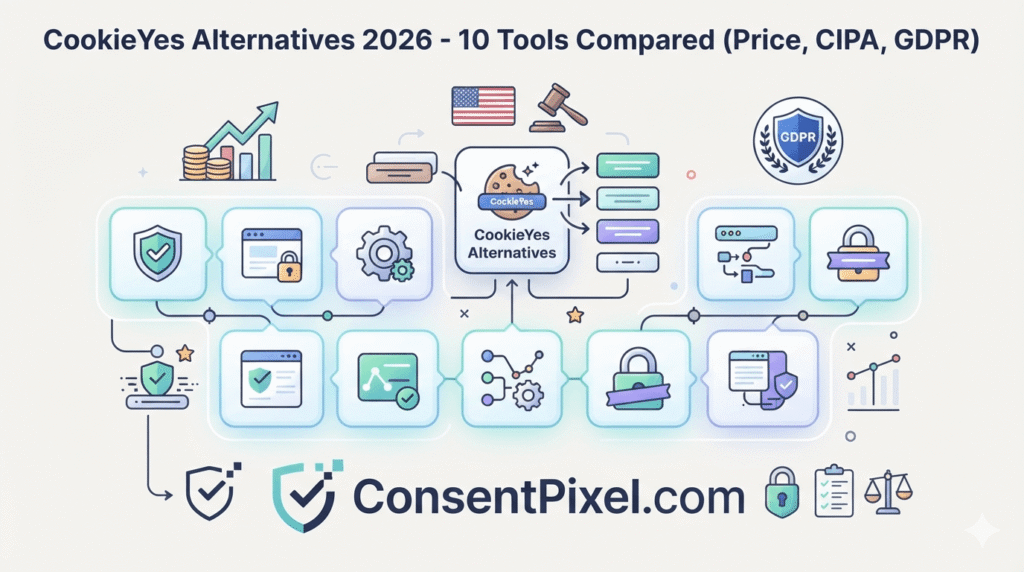
CookieYes Alternatives 2026 – 10 Tools Compared (Price, CIPA, GDPR)

CookieYes is one of the most popular cookie consent tools in the world — but its per-domain pricing, pageview overages, and feature-gating push a lot of teams to look elsewhere as they scale. If you’re evaluating a CookieYes alternative, this is the current 2026 comparison: 10 tools ranked on what actually matters — multi-domain value, GDPR depth, US state law and CIPA coverage, GCM v2, and pricing predictability.

CookieYes Alternatives 2026 – 10 Tools Compared (Price, CIPA, GDPR) Read Post »
Termly Alternative 2026: CIPA-First Consent Management Compared
Alternatives

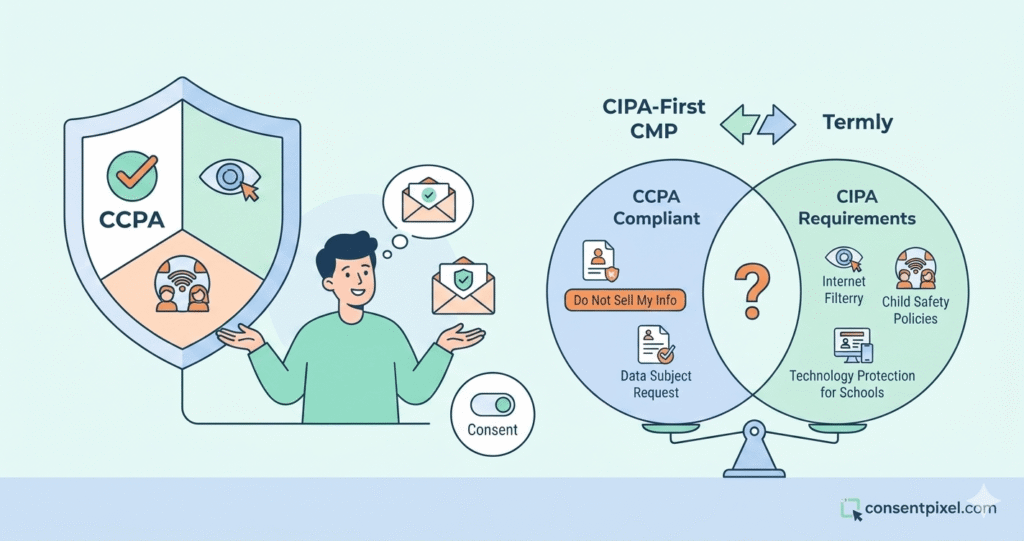
Termly Alternatives 2026: CIPA-First Consent Management Compared

Termly is a genuinely good all-in-one compliance tool — attorney-crafted legal policies and a cookie banner in one dashboard. But if you’re a US-based business, two things push teams to look for a Termly alternative: its documented struggles with multi-region compliance (over-blocking cookies in opt-out US regions), and the fact that its most important consent features sit behind the Pro+ tier. Here are 8 alternatives compared on what actually matters in 2026 — US multi-region handling, CIPA protection, price, and GDPR depth.

Termly Alternatives 2026: CIPA-First Consent Management Compared Read Post »

CCPA Compliant, but Still Got a CIPA Letter? You're Not as Covered as You Think
CIPA & Legal Risk

CCPA Compliant, but Still Got a CIPA Letter? You’re Not as Covered as You Think

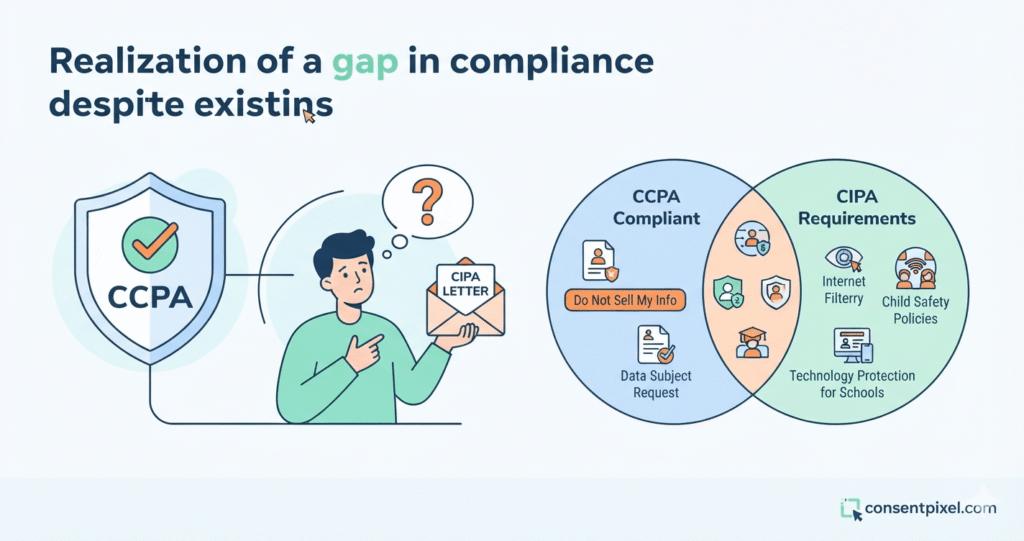
You built the cookie banner. You added the “Do Not Sell or Share” link. You’re CCPA compliant — so how did a CIPA demand letter still land on your desk? The uncomfortable answer: CCPA compliance and CIPA compliance are two different things, and the gap between them is exactly where the 2026 wave of website lawsuits lives. Here’s the gap, in plain English, and how to close it.

CCPA Compliant, but Still Got a CIPA Letter? You’re Not as Covered as You Think Read Post »

CIPA Explained: The Law Behind the Lawsuits
CIPA & Legal Risk

CIPA Explained: The Law Behind the Website Lawsuits (2026)

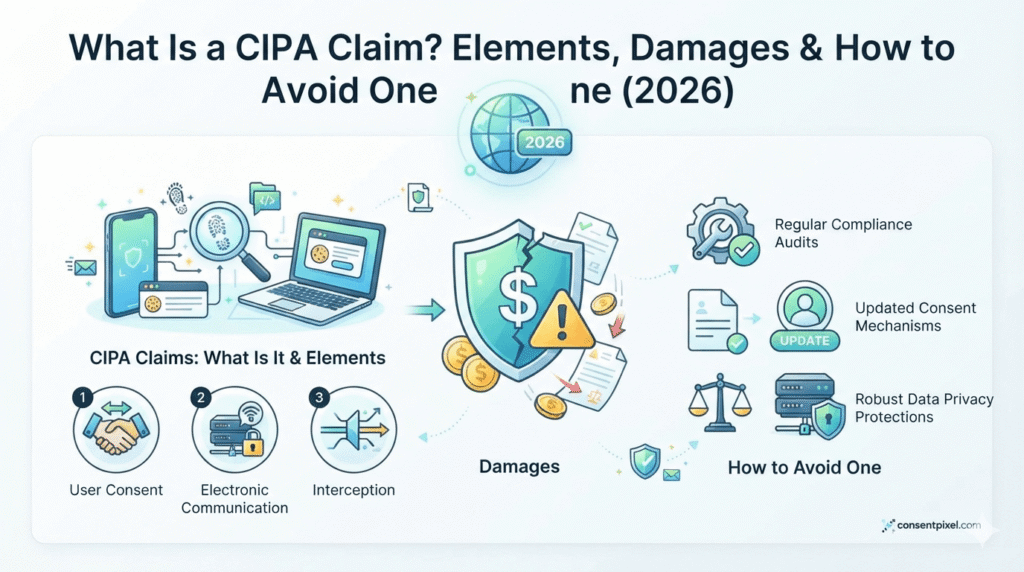
How did a California wiretapping statute written in 1967 — decades before the web existed — become the engine behind thousands of website tracking lawsuits? This is the story of the California Invasion of Privacy Act: the two court rulings that opened the floodgates, the “pen register” theory driving today’s demand letters, and why, in 2026, your everyday analytics and ad pixels put your site in the crosshairs.

CIPA Explained: The Law Behind the Website Lawsuits (2026) Read Post »

GDPR vs CIPA: One Configuration Handles Both
CIPA & Legal Risk

GDPR vs CIPA: One Configuration Handles Both

If you run websites for both European and American audiences, you’ve probably wondered whether you need two different consent setups — one for GDPR, one for California’s CIPA. The reassuring answer: a single, correctly built prior-consent configuration can satisfy both. Here’s how the two laws actually differ, where they converge, and the one setup that covers you on both sides of the Atlantic.

GDPR vs CIPA: One Configuration Handles Both Read Post »

Ortiz v. Foris Dax, Inc. (Crypto.com)
CIPA Cases

Ortiz v. Foris Dax (Crypto.com) — CIPA Case Deep-Dive

The plaintiffs clicked “Disable All” — and, they allege, the tracking kept running anyway. A federal court dismissed their wiretapping claim but let the pen-register claim proceed, in one of the most thorough federal endorsements yet of the theory that cookies can be illegal “pen registers.” Here’s the full breakdown, and why the “Disable All” detail should worry every site with a consent banner.

Ortiz v. Foris Dax (Crypto.com) — CIPA Case Deep-Dive Read Post »

The Pen-Register Defense Is Turning — What the Shift Means for Your Website
CIPA & Legal Risk

CIPA Case Watch: The Pen-Register Defense Is Turning — What It Means for Your Website (July 2026)

Something changed this cycle. For two years, the CIPA §638.51 “pen register” theory was the plaintiff bar’s most reliable weapon against websites. Now a line of defense rulings — led by Rodriguez v. Ink America — is spreading, holding that CIPA can’t criminalise what the CCPA already regulates. But federal courts still disagree. Here’s the shift, the split, and what both mean for your site.

CIPA Case Watch: The Pen-Register Defense Is Turning — What It Means for Your Website (July 2026) Read Post »

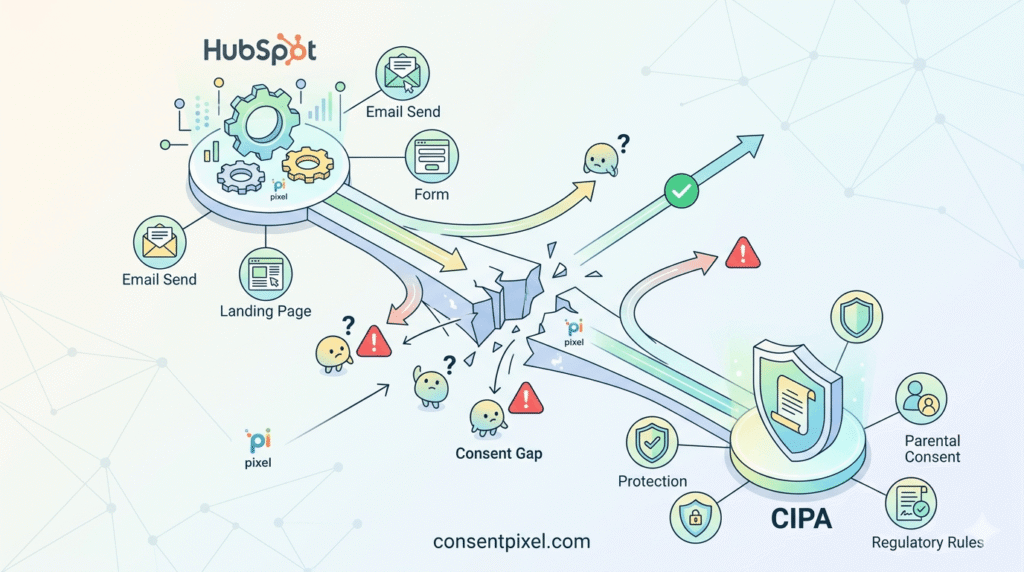
HubSpot Marketing and CIPA: Is Your HubSpot Configuration Creating Consent Gaps?
Tracking Pixel

HubSpot Marketing and CIPA: Is Your HubSpot Configuration Creating Consent Gaps?

HubSpot is the all-in-one marketing platform agencies deploy on hundreds of client sites. Its tracking code fires on page load by default. Its native consent banner — even after the May 2026 v2 migration — is designed as a notification tool, not a consent gate. And HubSpot is now explicitly named in active CIPA demand letters. Here’s exactly where the gaps are, which configurations are vulnerable, and what agencies need to fix for every client running HubSpot.

HubSpot Marketing and CIPA: Is Your HubSpot Configuration Creating Consent Gaps? Read Post »

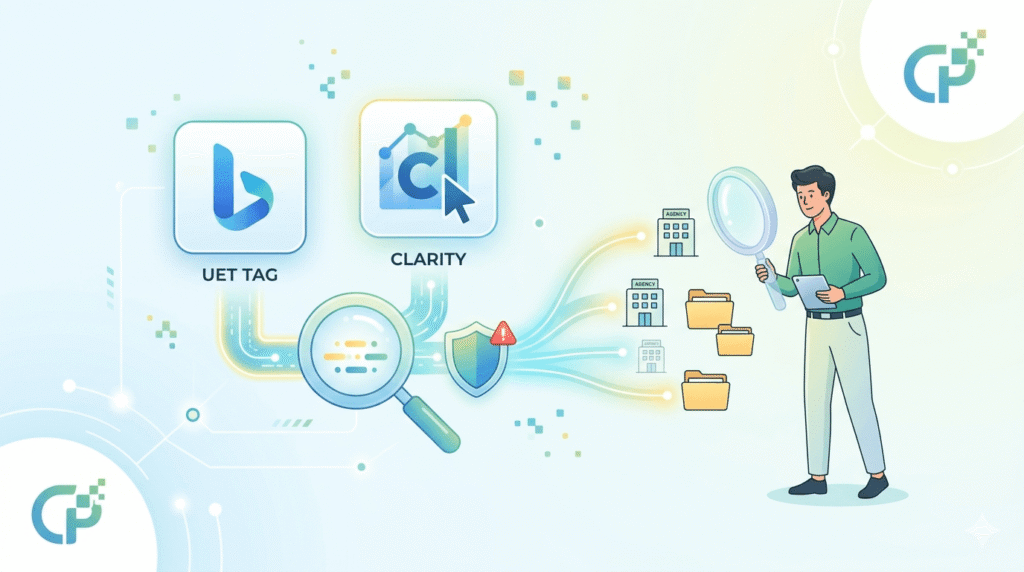
Microsoft Bing UET Tag and Microsoft Clarity: The CIPA Exposure Agencies Are Overlooking
Tracking Pixel

Microsoft Bing UET Tag and Microsoft Clarity: The CIPA Exposure Agencies Are Overlooking

Microsoft Bing UET is named as a pen register in Camplisson v. Adidas (November 2025). Microsoft Clarity and the Bing UET tag together generated a $10 million CIPA settlement for Forbes in May 2026. Most agencies treat Microsoft as the safe, enterprise-grade tracking option. The case law says otherwise. Here’s what each tool captures, why the CIPA exposure is real, and the specific configuration changes agencies need to make across every client running Bing Ads or Clarity.

Microsoft Bing UET Tag and Microsoft Clarity: The CIPA Exposure Agencies Are Overlooking Read Post »

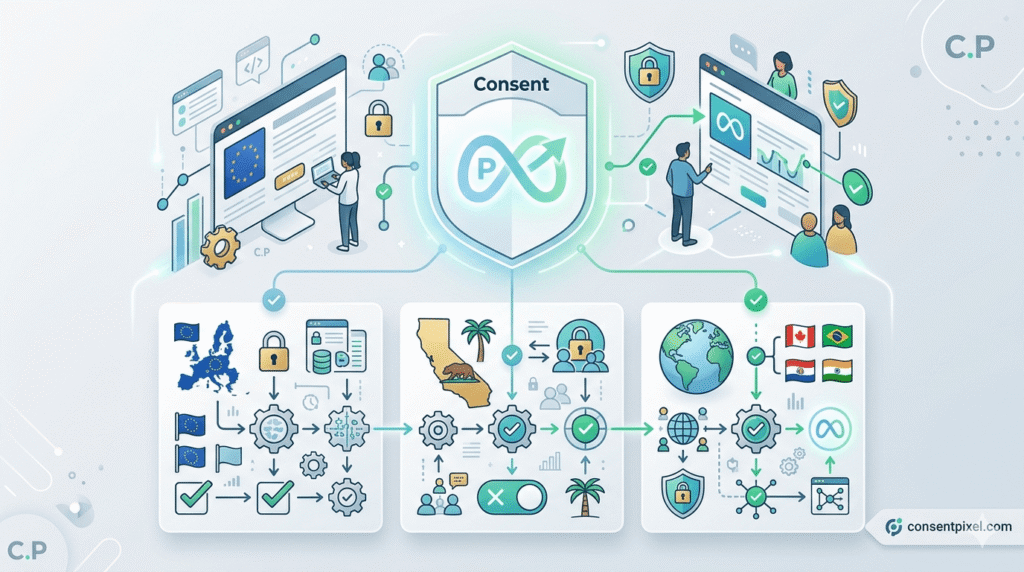
Meta Pixel Consent Requirements: A Framework-by-Framework Breakdown for Agencies
Tracking Pixel

Meta Pixel Consent Requirements: A Framework-by-Framework Breakdown for Agencies

The Meta Pixel consent requirements vary by legal framework, visitor geography, feature set, and page type. What CIPA requires is different from GDPR. What Advanced Matching requires is different from the base pixel. What checkout pages require is different from blog pages. This article maps every scenario agencies actually manage — precisely, with case law to back each requirement.

Meta Pixel Consent Requirements: A Framework-by-Framework Breakdown for Agencies Read Post »

UK Cookie Law 2026: What PECR and the ICO's New Guidance Actually Require
UK Compliance

UK Cookie Law 2026: What PECR and the ICO’s New Guidance Actually Require

The ICO published finalised guidance on tracking technologies on April 29, 2026 — the most significant update to UK cookie rules since GDPR. The Data Use and Access Act raised PECR fines from £500,000 to £17.5 million. Three new cookie exemptions came into force in February 2026. This is the complete picture of what UK websites must do now — including what changed, what didn’t, and where agencies are still getting it wrong.

UK Cookie Law 2026: What PECR and the ICO’s New Guidance Actually Require Read Post »

Tracking Pixel

TikTok Pixel Lawsuit: The CIPA Case Law Whipsaw Every Agency Running TikTok Ads Must Understand

In April through August 2025, three courts dismissed CIPA claims against the TikTok Pixel. In November 2025, a federal court in Camplisson v. Adidas found the TikTok Pixel could plausibly qualify as a pen register under CIPA — explicitly rejecting the earlier cases. The result is a genuine circuit split that leaves agencies running TikTok Ads on client sites in a legally uncertain but practically urgent position. Here’s the full picture.

TikTok Pixel Lawsuit: The CIPA Case Law Whipsaw Every Agency Running TikTok Ads Must Understand Read Post »

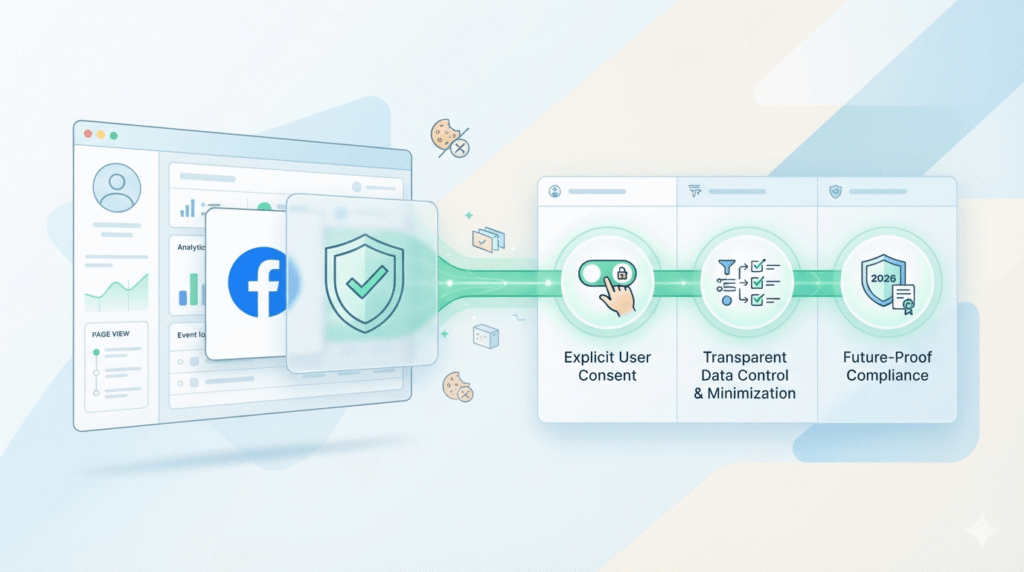
Does Meta Pixel Need Cookie Consent? The Answer Is More Complicated Than You Think
Tracking Pixel

Does Meta Pixel Need Cookie Consent? The Answer Is More Complicated Than You Think

Short answer: yes. But “cookie consent” is actually the wrong frame for US businesses. The Meta Pixel creates legal exposure under a 1967 California wiretapping law — not just cookie regulations — and the consent standard it requires is stricter, more specific, and far more technically demanding than the banner most agencies have installed. Here’s what’s actually required, what isn’t enough, and what happens when you get it wrong.

Does Meta Pixel Need Cookie Consent? The Answer Is More Complicated Than You Think Read Post »

Meta Pixel GDPR Compliance: What EU and UK Websites Must Do in 2026
UK Compliance

Meta Pixel GDPR Compliance: What EU and UK Websites Must Do in 2026

In August 2025, Swedish data protection authorities fined multiple pharmacy chains €15 million for deploying Meta Pixel without proper consent. The ruling made one point clear: when it comes to tracking pixels under GDPR, liability sits with you as the website operator — not with Meta. Here’s exactly what GDPR requires for Meta Pixel, what the enforcement record looks like across Europe, and the exact configuration every EU and UK website must have in place.

Meta Pixel GDPR Compliance: What EU and UK Websites Must Do in 2026 Read Post »

Canada Cookie Compliance 2026: What PIPEDA, CASL, and Quebec Law 25 Require for Website Tracking
International

Canada Cookie Compliance 2026: What PIPEDA, CASL, and Quebec Law 25 Require for Website Tracking

Most website owners assume Canada has a permissive, opt-out approach to tracking — similar to the US. It doesn’t. Quebec’s Law 25 is the only privacy law in North America that requires explicit opt-in consent before any tracking technology fires. Fines reach CAD $25 million or 4% of global revenue. And it applies to you even if your business has never set foot in Quebec.

Canada Cookie Compliance 2026: What PIPEDA, CASL, and Quebec Law 25 Require for Website Tracking Read Post »

GDPR Cookie Consent Requirements 2026: What Every Website Serving EU Visitors Must Know
GDPR & EU Compliance

GDPR Cookie Consent Requirements 2026: What Every Website Serving EU Visitors Must Know

In September 2025, France’s CNIL fined Google €325 million and Shein €150 million for cookie violations — in a single day. In 2025 alone, European regulators issued €1.2 billion in GDPR penalties. The rules have not changed dramatically, but the enforcement has. Here is exactly what GDPR cookie consent requires in 2026, where most websites still get it wrong, and what a compliant implementation actually looks like.

GDPR Cookie Consent Requirements 2026: What Every Website Serving EU Visitors Must Know Read Post »

Google Analytics CIPA Compliance: What Every Agency Needs to Know About GA4 and California Law
Tracking Pixel

Google Analytics CIPA Compliance: What Every Agency Needs to Know About GA4 and California Law

Most agencies treat Google Analytics as the “safe” tracker — lower profile than Meta Pixel, owned by Google, surely fine. In 2024, a court named Google Analytics specifically in a CIPA claim and let it proceed. In 2025, a Blue Shield of California misconfiguration sent 4.7 million patients’ health data to Google Ads for three years. Google Analytics has a CIPA exposure profile that’s different from Meta Pixel — and in some ways more insidious. Here’s what agencies need to know.

Google Analytics CIPA Compliance: What Every Agency Needs to Know About GA4 and California Law Read Post »

Your Shopify Pixel App Is Not Your Privacy Compliance
Tracking Pixel

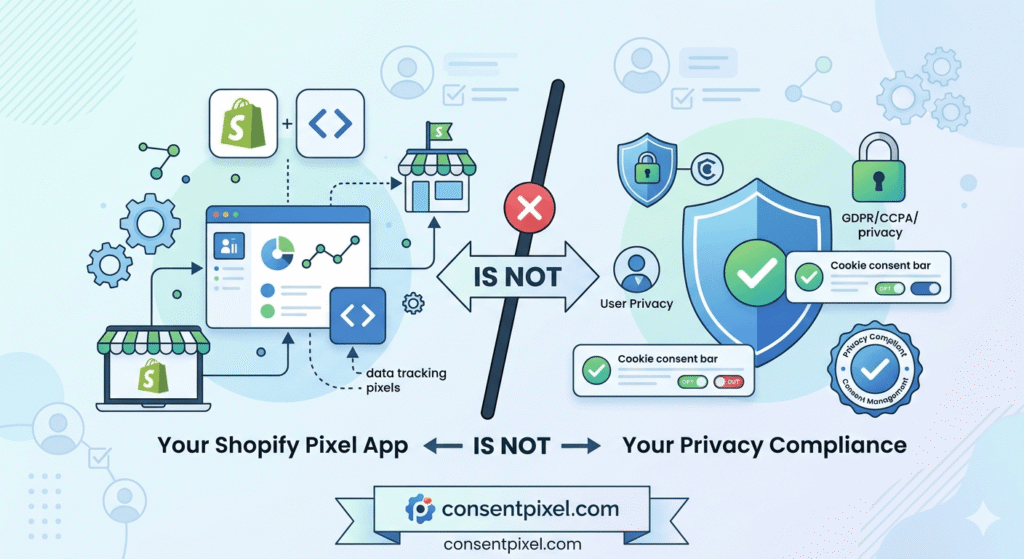
Your Shopify Pixel App Is Not Your Privacy Compliance

There are 1,919 apps in the Shopify App Store when you search “meta.” Trackify. Omega Pixel. CAPI Facebook Pixel Meta API. Parkour. Every single one installs pixels. Not one of them is a consent management platform. Installing a pixel app does not make your store CIPA-compliant. Here’s the gap most Shopify merchants don’t know exists — and what actually closes it.

Your Shopify Pixel App Is Not Your Privacy Compliance Read Post »

You Installed the Pixel App. You May Own the Compliance Problem.
Tracking Pixel

You Installed the Pixel App. You May Own the Compliance Problem.

Agencies buy pixel management apps through Shopify partner accounts and roll them out across dozens of client stores simultaneously. The clients assume the agency handled compliance. The agency assumes the app handles compliance. Nobody installs the CMP. The CIPA demand letter arrives at the client’s door — but under California’s aiding-and-abetting clause, the agency that deployed the configuration may be in the chain of liability too. Here’s the exposure and what to do about it across your entire Shopify portfolio.

You Installed the Pixel App. You May Own the Compliance Problem. Read Post »

Scroll to Top